If you signed a private agreement with your bank to reduce the floor clause and lower your mortgage interest rate, it may be possible to have it set aside. Many consumers believe that by accepting a reduction they gave up their right to claim. However, current case law clearly opens the door to invalidating these documents. In this article, we explain how you can recover your money, based on the recent Judgment No. 273/2026 of the Barcelona Provincial Court, obtained by BBS Abogados.
What is a floor clause reduction agreement and why is it void?
A floor clause reduction agreement is an amendment (novation) under which the bank offers to lower the minimum interest rate. In return, the bank usually requires the customer to waive any future legal action.
However, these agreements often lack the necessary transparency. The Supreme Court and the CJEU have established that consumers must understand the real financial consequences of what they sign. If the bank did not explain how much money you were giving up by not recovering what you had overpaid, the agreement can be challenged.
What does Judgment 273/2026 say about floor clause reduction agreements?
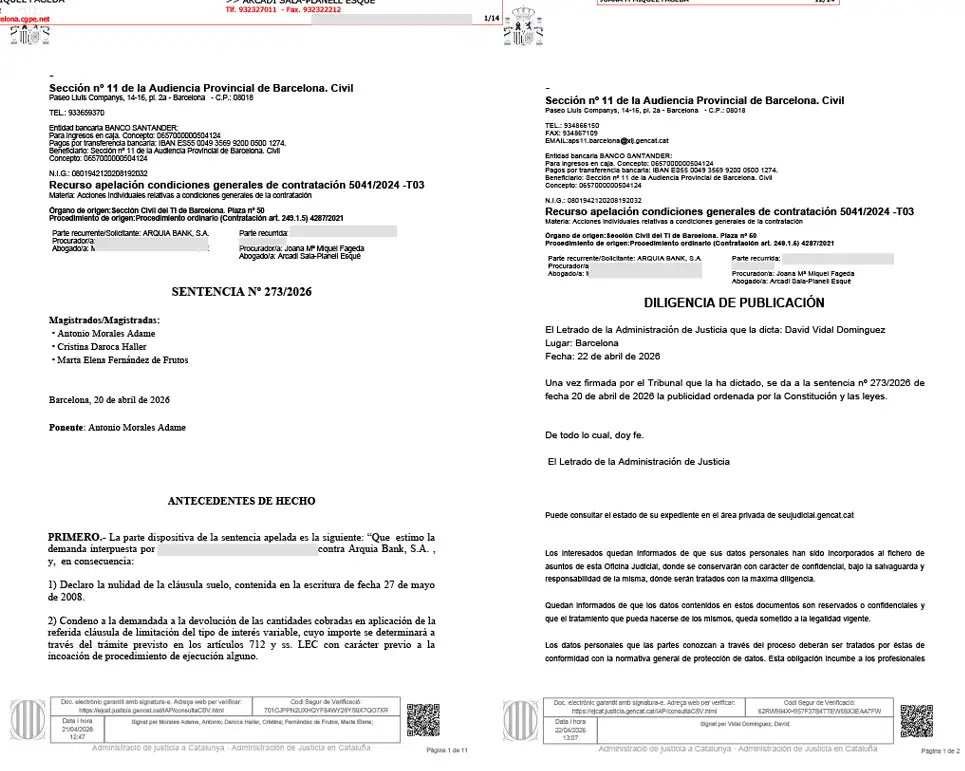
The Barcelona Provincial Court (Section 11) judgment of 20 April 2026 is crucial. In this case, Arquia Bank, S.A. appealed against an earlier judgment that had declared its floor clause void.
Is a waiver of legal action in a floor clause reduction agreement valid?
The court considers whether a settlement agreement prevents a claim. It finds that, although the amendment itself (lowering the interest rate) may be valid, the waiver of legal action is usually void, particularly if the consumer was not given the information needed to estimate the sums being waived.
What information should the bank have given you?
The courts require the bank to provide all the necessary information. The bank must therefore disclose the specific amount overpaid before the agreement is signed. In the case in question, the Provincial Court upheld the nullity because there was no evidence that the bank had provided prior information on the significance of the clause.
What interest can you claim under your floor clause reduction agreement?
The refund is not limited to the principal. You are entitled to statutory interest from the date of each overpayment.
The judgment stresses that a finding that a clause is unfair is equivalent to bad faith on the part of the bank. Interest therefore accrues from the date of each payment, regardless of when you bring your claim.
Is the transparency test the key to setting aside your floor clause reduction agreement?
Yes. Transparency is not just about clear wording. The court assesses whether the consumer understood that, although the interest rate was variable, there was a minimum rate that prevented them from benefiting when Euribor fell.
If the clause was “hidden” among complex financial formulas, the judge will declare it void. Pre-contractual information is what allows consumers to compare offers, and its absence is fatal to the validity of the banking contract.
Why choose BBS Abogados for your banking claim?
Choosing the right advice determines the outcome of your case. At BBS Abogados, we specialise in banking law. As a “boutique” law firm, we offer an exclusive, highly specialised service. Our firm focuses on banking and financial law and has more than 25 years’ experience, backed up by our regular presence in the media. We are a pioneering firm in Spain, with offices in Barcelona and acting throughout the country.